
GOTS vs OEKO-TEX explained: a guide for eco-minded quilters
As quilters, we care about the materials we use – not just for their beauty and feel, but for the stories they carry forward. Whether you’re sewing for a new baby, donating to a charity, or creating a piece to last for generations, it matters what’s in your fabric.
In recent years, you may have noticed labels like GOTS or OEKO-TEX on the selvage of your fabric or on fabric manufacturer websites. These aren’t just marketing buzzwords – they’re certifications that tell you something important about how that fabric was made. But what do they actually mean?
In this post, I’’ll give a comparison between GOTS vs OEKO-TEX, whether they impact the quality of fabric and how these certifications can help you make safer, more sustainable choices as a quilter. I’ve also included a Quilting Fabric Quality Checklist and Guide that you can download!
What is GOTS?
GOTS means Global Organic Textile Standard. This is the leading textile processing standard for organic fibers worldwide, including environmental, human rights and social criteria. It’s also backed up by independent third-party certification which applies to the entire supply chain. Key features include:
- No child labor.
- Working hour limits.
- Ensures well-being, safety, and fairness for all workers.
- No toxic dyes used.
- Must contain a minimum of 70% certified organic fibers.
- Strict requirements for wastewater treatment and waste management.
- Ensures traceability of the cotton throughout the supply chain, from farm to finished product.
What is OEKO-TEX?
OEKO-TEX is a global certification system for textiles and leather products, ensuring they are tested for harmful substances. There are several labels and certifications available.
- The most common label for quilting cotton is OEKO-TEX® STANDARD 100. This focuses on chemical safety and indicates a product has been tested for over 1,000 harmful substances.
- The ORGANIC COTTON certification includes products that have been tested for the use of GMO’s (genetically modified organisms), pesticides and other harmful substances. This certification greatly supports sustainability, soil health, regenerative farming and biodiversity. In my research, I didn’t see this certification in any quilting cottons.
Comparing GOTS vs OEKO-TEX
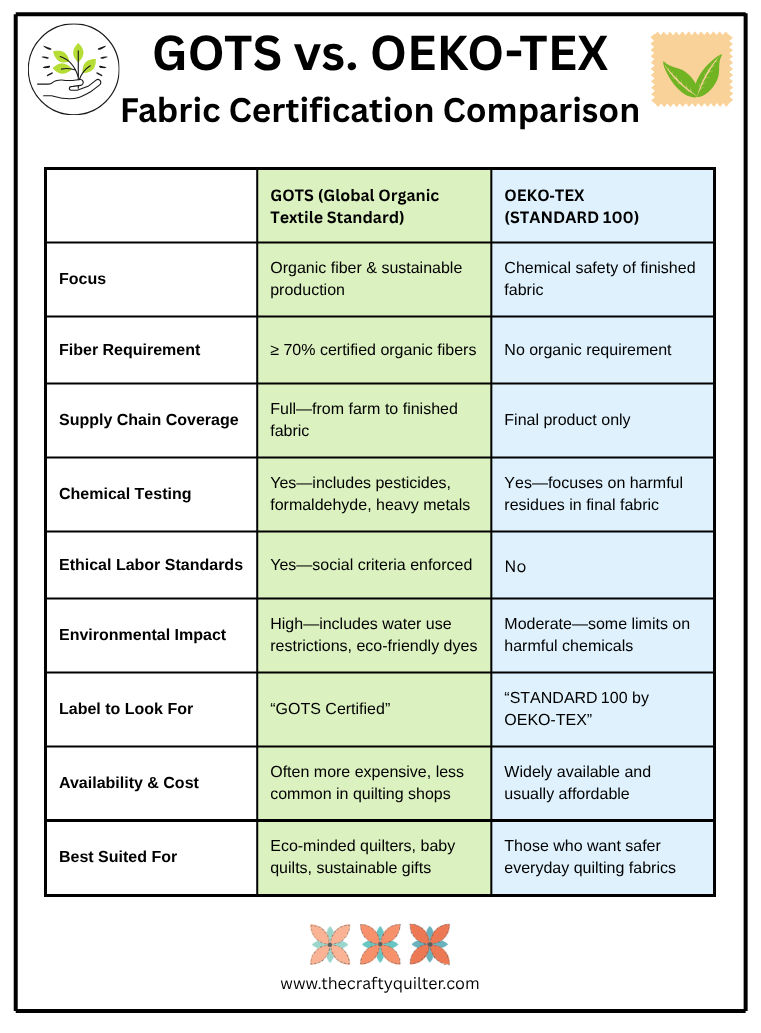
Both of these certifications are a step in the right direction towards a more sustainable future. In general, GOTS covers more of the supply chain and materials, while OEKO-TEX focuses on end-product safety. Below is a chart comparing both GOTS and OEKO-TEX to help you make informed purchases. Feel free to Pin this chart for future reference!
Does certification affect the quality of fabric?
You may be wondering if a certification on your latest fabric purchase impacts the quality. Let’s take a closer look at how each certification might influence the character of fabric.
GOTS:
Yes, it affects the quality to some extent. GOTS-certified fabrics must meet strict environmental and social standards throughout the supply chain, including fiber quality and processing. This often results in:
- Fewer chemicals = less fabric degradation
- Stronger, longer-staple cotton (especially in higher-end organic lines)
- Consistent dyeing with low-impact, fiber-safe dyes
Conclusion: GOTS often aligns with higher-quality, longer-lasting fabric – but the focus is on sustainability, not just durability or hand-feel.
OEKO-TEX:
Not necessarily. OEKO-TEX certification means the fabric is safe for human use – free of harmful substances. It doesn’t evaluate:
- Fiber strength
- Thread count
- Weave consistency
- Fade resistance
- Shrinkage or pilling
Conclusion: You can have a cheap, low-quality fabric that is OEKO-TEX certified. It just means it’s not toxic, not that it’s well-made.
What Actually Affects Fabric Quality (especially for quilting)?
1. Fiber Type & Staple Length
- Long-staple cotton (like Pima or Egyptian) = smoother, stronger threads.
- Shorter fibers = more fraying, rougher texture, more lint.
2. Thread Count & Yarn Size
- Quilting cottons are usually 68 x 68 threads per inch or better.
- Higher thread count = denser weave, better drape, less fraying.
- Cheap fabrics often have thin threads and looser weave.
3. Finishing & Sizing
- High-quality fabrics are “finished” well: even surface, soft hand, and no excess sizing (starch can be used to stiffen cheap fabric).
- Look for minimal bleeding or strong odor – signs of poor dye quality.
4. Colorfastness & Print Quality
- Does it bleed when washed?
- Are the colors rich and crisp?
- Quality prints have good dye penetration and alignment.
5. Brand Reputation
- Well-known quilting fabric brands (such as Moda, Art Gallery, Andover, Riley Blake) are consistent in quality.
- Many use OEKO-TEX or low-impact dyes, even if not labeled.
6. Feel & Drape
- A “quilter’s hand” = soft but crisp; holds its shape well.
- Avoid limp, slippery, or overly stiff fabrics (these may shrink, stretch, or fray unpredictably).
✂️ Tip for Quilters:
Certifications like GOTS and OEKO-TEX are bonuses, not replacements for quality fabric.
Use them to guide safer, more ethical choices – but still pay attention to the touch, weave, and brand reputation when choosing your quilting fabric.
Free Fabric Quality Checklist & Guide
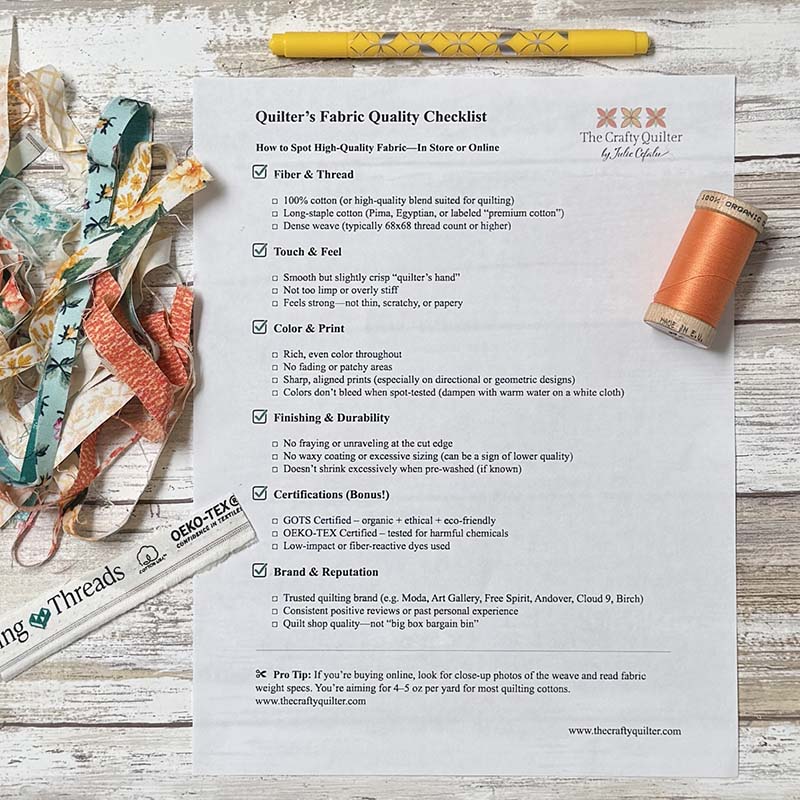
You can download my free Quilter’s Fabric Quality Checklist below!
Where to find organic quilting fabric
The following list includes manufacturers who produce organic, GOTS certified fabric. I focused on quilting cotton fabrics, so this is not a comprehensive list per se.
- Birch fabrics
- Monaluna Organic Fabric (now part of the Windham Fabric family)
- Cloud9 Fabrics
- Robert Kaufman Fabrics (Mammoth Organic Flannel only – not GOTS certified)
- Clothworks (Everyday Organic Solids)
Where to find OEKO-TEX certified cotton fabric
The following list includes manufacturers who produce OEKO-TEX certified fabric. I hope more fabric companies follow the sustainability trend and broaden the availability of these chemical-safe fabrics.
- Art Gallery Fabrics
- Robert Kaufman – Kona solids collection only
- Windham Fabrics
- Riley Blake Designs
- Connecting Threads
More resources
If you’re interested in more ways you can build a sustainable fabric collection, check out my blog post, 5 Ways Quilters Can Honor Earth Day, and my Scanfil Organic Thread Review.
Final Thoughts
We have so many options when choosing fabric for a quilt. Our first thought is color and pattern, but if you want to make more mindful decisions then consider product safety, sustainability, and quality. Remember that GOTS and OEKO-TEX certifications can guide you toward fabrics that are eco-friendly and non-toxic, but they don’t automatically guarantee top-notch quilting quality. That’s why it’s important to also consider factors like fiber type, thread count, weave density, and brand reputation. Eventually you can build a stash that’s beautiful, long-lasting, and made with intention.
Discover more from The Crafty Quilter
Subscribe to get the latest posts sent to your email.

Great post, super helpful and written in a factual unbiased way. Thank you so much for helping fellow quilters be more conscientious and knowledgable with our purchases!
Just a note in passing: GMO products are not going to kill us all, at least not yet. In reality, most genetically modified plants have simply been designed to have superior properties, like improved resistance to frost or to harmful infectious organisms that can attack the plant. In simplest terms, a gene for the superior trait in a well-studied plant is copied and transferred to another well-studied plant that doesn’t have the trait. The genetic sequences of these plants are well known, and the insertion points are not random. After all, plants absolutely need certain genes to survive and reproduce, and disrupting them by randomly inserting another gene could kill the plant. Kind of defeats the purpose of re-engineering the plant in the first place if it were to happen.
Another factor to consider is that plants re-engineer themselves when they cross-breed with plants or simply have a random mutation. This has happened throughout the time that plants have existed and is still happening today by the processes of mutation and natural and artificial. Humans have also played a big role in “re-engineering” plants for thousands of years. The corn on the cob that we eat today is nothing like the original corn. Ditto peaches, apples, and other fruit. The original peach, for example, started out with fruit about the size of a cherry and has been “clonally” selected and cultivated for over 7000 years, resulting in the gradual development of the nice, big juicy peaches we eat and love today.
Closer to home and our time, the Hass avocado “engineered” itself when the variety simply appeared at random on one branch of another type of avocado tree. As I understand it, one of the men working in the orchard brought them to the attention of his boss after they initially dismissed them as ugly mutants. Turns out people were looking at the rough, dark peel and had not tasted these delicious morsels. So much better than the old “Alligator pears” that I grew up with. All of the Hass avocados that we eat today are derived from cuttings from this branch that were grafted onto other trees. I don’t know of anyone who is afraid of eating Hass avocados because they are “frankenfruit”. In reality, grafting has allowed botanists to “engineer” trees by grafting branches that produce fine fruit onto trees that are tough and grow well, but may not have the “best” fruit.
Genetically modified cotton, with its greater resistance to both diseases and harsh environmental conditions has reduced pesticide use and allowed the plant to be grown in areas with more variable weather and in soil with higher salinity. Isn’t reducing pesticide use supposed to be a good thing?
What keeps me up at night is the thought that genetic engineering can be used for harmful things, like engineering micro-organisms that are worse pathogens than their wild cousins found in nature or that unintended consequences, such as having an engineered plant out-breed native plants and disrupt entire ecosystems, could result. Think I’m “off”? Maybe, but I don’t think that anyone expected the rapid evolution of antibiotic-resistant TB strains, for example. Pretty soon we’ll be back to the bad old days of isolating TB patients to prevent the spread of the disease because it is so antibiotic resistant that nothing cures the patient. Meanwhile, I will go back to quilting with cotton fabric…
PS: These are my ruminations based on information I acquired as a student or read about in other sources. I can always make mistakes or fail to understand something myself, so pls. feel free to correct me if I am in error.
Thank you so much for your post about more sustainable and eco-friendly fabrics. This is a drum I’ve been banging for a long time. I am an ardent supporter of the GOTS system. It has such an incredible impact when someone like yourself does this kind of post. Thank you, thank you thank you.
Now, how about a post about Minky and micro plastics?
Thank you for being you,
Jennifer
Thank you Julie for taking the time /energy you expended on researching GOT vs OEKO-TEX. Equally appreciated are the fabric company names that offer sustainable and chemical-safe fabrics.
Art Gallery fabrics are one of my favorite fabrics because they have a soft hand, feel incredible, no chemical smell, and less fraying. Thanks, too, for giving indepth details on affects of fabric quality!
Great info, thank you! The child labour, working hour limit, wellbeing & safety, and wastewater management are important to me, but organic pesticides are such a scam that are still dangerous to humans so the 70% minimum organic cotton is definitely not a draw for me! But the other concerns are, so I’ll keep an eye out for such certifications, as well as the other points about fabric quality that you detailed.
Julie,
Thank you iso much for sharing this information. I didn’t know about this and am grateful to have this information I will be more aware of the fabric I purchase, and the list of companies is so helpful.
Thank you,
Linda Brennan
I never gave this much thought, I usually just saw fabric that caught my eye and went with it!!! However, now I can buy with an informed and educated idea. Thank you so much for bringing this to light!!